Help shape the future of infrastructure intelligence.
We are inviting 10 experienced infrastructure teams and MSPs to help test, challenge and shape IntraLogic before its broader release.
Limited to 10 Founding Partner organisations.
Small enough that every partner gets a direct line and real influence over what gets built next. Large enough to cover genuinely different environments.
Not a free tier, and not a queue. Applying does not guarantee acceptance — we are looking for a spread of environments we can actually learn from.
One infrastructure model across your environment.
IntraLogic discovers infrastructure across virtualization, storage, networking, servers, applications and related systems. It correlates what it collects into a connected model that helps teams understand dependencies, investigate issues, prepare documentation and evaluate infrastructure changes.
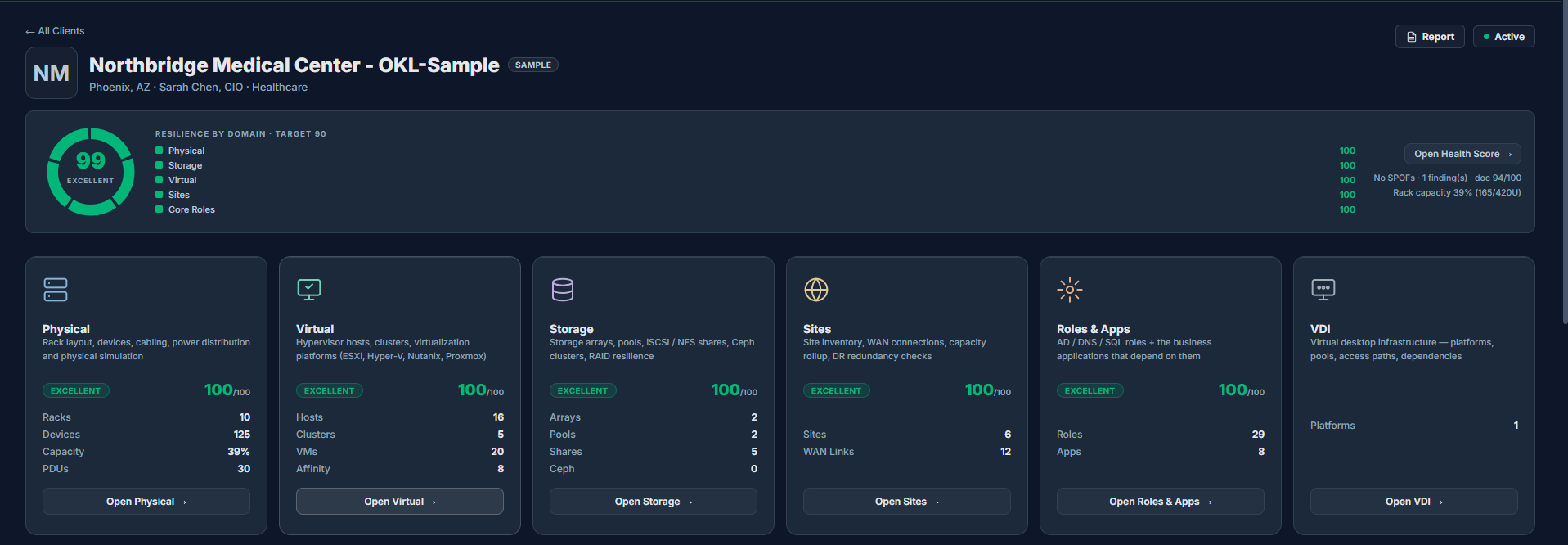
Why we are building it.
Fragmented infrastructure data
Infrastructure information is distributed across vendor portals, monitoring tools, spreadsheets, diagrams and individual knowledge.
Outdated documentation
Static documentation becomes inaccurate as soon as the infrastructure changes, and it rarely changes back.
Difficult dependency tracing
Teams end up working out by hand how applications, virtual machines, hosts, storage and networks depend on one another.
Risky maintenance decisions
It is hard to know what taking a device, path, host, switch or storage component offline will actually affect.
What works today.
Everything below is in the product now. Where something is newer or less travelled, it says so rather than sitting in the same list as the mature parts.
| Capability | Status |
|---|---|
| Read-only discovery connectorsVirtualization, storage, network, firewall and server hardware | Available |
| Normalization and correlationDiscovered objects reconciled into one model by identity, in any import order | Available |
| Cross-platform relationship mappingEvidence recorded per link; low-confidence matches go to review | Available |
| Device, VM, switch and array records | Available |
| Dependency tracing and path explorerFollows discovered links, not only hand-drawn cabling | Available |
| Failure simulation and blast radiusIncluding redundancy-loss states where nothing is down | Available |
| Resilience health score and findings | Available |
| Infrastructure search and AI assistantAnswers from your own modelled environment | Available |
| Change history and activity feedField-level change detection with source IP on sign-ins | Available |
| Documentation workflowsGenerated from the model; flagged out of date when the model moves | Available |
| Reporting and exportsCSV, PDF and HTML | Available |
| Scheduled discoveryInterval-based; recently landed and not yet field-soaked | Private Preview |
| Application and process discovery | In Development |
| Root-cause correlation | In Development |
| Additional discovery adaptersSee the platform catalogue for what is available today versus catalogued | Planned |
The per-platform list — which vendors are connected today and which are catalogued — lives on How It Works and is the single source of truth for it. We would rather link to it than keep a second copy that drifts.
Where IntraLogic is going.
Available now
Discovery, normalization, relationship mapping, dependency tracing, simulation, health scoring, findings, documentation and reporting — the table above.
Currently building
Application and process discovery, deeper dependency mapping, root-cause correlation, better change intelligence, and further discovery adapters.
Longer term
Richer change simulation, advanced resiliency analysis, AI-assisted investigation, continuously updated documentation, and broader multi-vendor coverage.
There are none here on purpose. The roadmap may change based on technical validation and on what Founding Partners tell us — which is rather the point of the programme.
Who we are looking for.
People responsible for a real environment, who will tell us plainly when something does not work.
Infrastructure and systems
Enterprise infrastructure engineers, systems administrators, virtualization engineers.
Network and storage
Network engineers, storage engineers, and the architects who have to join them up.
Leadership and MSPs
Infrastructure architects, IT managers, MSP owners and senior MSP engineers.
The environments we learn most from
Combinations, rather than any single platform — VMware or Hyper-V, Cisco networking, shared storage, physical servers, multiple sites, or an MSP running several client environments at once. You do not need all of these. A single-site environment with one hypervisor and a NAS is still useful to us if you will engage with it properly.
What Founding Partners receive.
Early access
Use the platform against a real environment well before general availability.
A direct line to the founder
Not a support queue, and not a ticket that gets triaged. Your feedback reaches the people making the decisions.
Real influence on the roadmap
Workflows and priorities genuinely move based on partner feedback — that is why the programme is ten organisations and not a thousand.
Priority onboarding
Help getting the agent deployed, credentials scoped and the first discovery run reviewed.
Early previews
New discovery capabilities before they are announced.
Input into usability and reporting
Including what the reports need to say to land with your own stakeholders.
On commercial terms
IntraLogic does not publish pricing yet — the commercial model is still being decided, and we are not going to advertise a number we might have to take back. Recognition for Founding Partners is discussed directly with each organisation before onboarding, in writing. Applying commits you to nothing.
What we ask from partners.
An onboarding session
One session to get set up properly, so the first discovery run is worth looking at.
An approved test environment
Somewhere you are authorised to point read-only discovery at.
Tell us what breaks
Bugs, confusing workflows, results that look wrong. Especially the results that look wrong.
Help validate what we found
Discovery and dependency output is only useful if someone who knows the environment confirms it.
Occasional feedback sessions
Scheduled around you, at a cadence you agree to. Not standing meetings you inherit.
Confidentiality on unreleased work
Previews stay between us until they ship.
This is a product-testing programme, not unpaid work. Sessions are arranged at a reasonable cadence and agreed with you, and you can leave the programme at any time without explanation or penalty.
Built from real infrastructure experience.
IntraLogic is built by infrastructure professionals with decades of hands-on experience across enterprise and MSP environments.
The product began from a recurring problem: even when organisations have strong monitoring and management tools, understanding how infrastructure components depend on one another still takes too much manual investigation and too much institutional knowledge held by too few people.
Designed for sensitive infrastructure environments.
You would be pointing this at production. The boundary is documented rather than asserted.
Read-only discovery
Collectors read inventory and configuration. A guard sits between the discovery code and the transport, and a mutating command aborts the run rather than executing.
Outbound only
The agent polls out over HTTPS. No inbound port, no firewall rule, no NAT entry, no VPN.
Encrypted in transit and at rest
Credentials are encrypted at rest and write-only through the API — they go in, they do not come back out.
Tenant isolation
Each client is a separate environment. The boundary is enforced in the application layer, and the trust centre says exactly that rather than implying something deeper.
Role-aware access and audit
Access scoped by organisation, client, module and role, with every sign-in and model change on the record.
Collection scoped to the connector
Each integration asks for a specific read-only scope, and the trust centre lists what each one can and cannot do with it.
Before you apply.
There is no charge to apply. Commercial terms, pilot scope and any paid usage are discussed before onboarding. Participation does not require an immediate long-term contract.
Enterprise IT teams, MSPs, infrastructure engineers, architects and technical leaders responsible for real infrastructure environments.
No — it is in early private testing, and we would rather say so. Core discovery, normalization, relationship mapping and the supporting workflows are functional; other capabilities are still being built and validated. General availability is planned for the first quarter of 2027.
It is designed around read-only discovery and should not make configuration changes as part of this programme. The trust centre describes the guard that enforces that, and the three places we consider the boundary imperfect.
Enough to onboard, run discovery against a real environment, test the workflows relevant to you, report what breaks, and join occasional feedback sessions arranged around your schedule.
Yes, and they are a priority. MSPs manage several environments at once, which makes them the best possible test of multi-tenant discovery and of the operational workflows around it.
We read it, and we get in touch if your environment looks like a fit for the current phase. We are deliberately not promising a response time we have not committed to operationally — but applications are read by a person, not filtered by a form.
No. Infrastructure data is not published or used in marketing without your explicit written permission. Product feedback may be aggregated or anonymised to improve the product internally.
Apply for early access.
Ten organisations. Tell us enough about your environment for us to judge whether it is a fit for this phase — nothing more than that.
Do not send us anything sensitive
This form is for qualification only. Please do not include credentials, IP addressing, configuration exports, hostnames or any other detail about your environment — there is no reason for us to have it before a conversation, and this form is not the place for it.